AI answering machine detection · Vicidial · Asterisk · FreeSWITCH · API

AI answering machine detection for ViciDial and outbound dialers. 10–20% more live talks.

Your dialer's built-in AMD (answering machine detection) decides if a human or a voicemail picked up. The stock version gets it wrong and drops an estimated 10-20% of live humans as voicemail (see our live measured data). AMDY listens to the answer itself and decides in 1/8 of a second at 99% accuracy. It also flags carrier false-answers (FAS): calls the carrier bills as connected that nobody answered. Native 5-minute install on ViciDial, Asterisk, or FreeSWITCH, or any dialer via API. 50,000 free detections.

Already have an account? Sign in

99% accuracy · starts detection in 1/8 of a second
5-minute ViciDial install
Catches carrier false-answers (FAS)
50,000 free detections
Legacy AMD Hangs Up On An Estimated
10-20% Of Live Customers

Standard ViciDial AMD and Asterisk answering machine detection use basic silence detection. When they guess wrong, they create ghost calls and dead air that burn leads and damage your caller ID reputation. Handset call screening adds a newer failure mode.

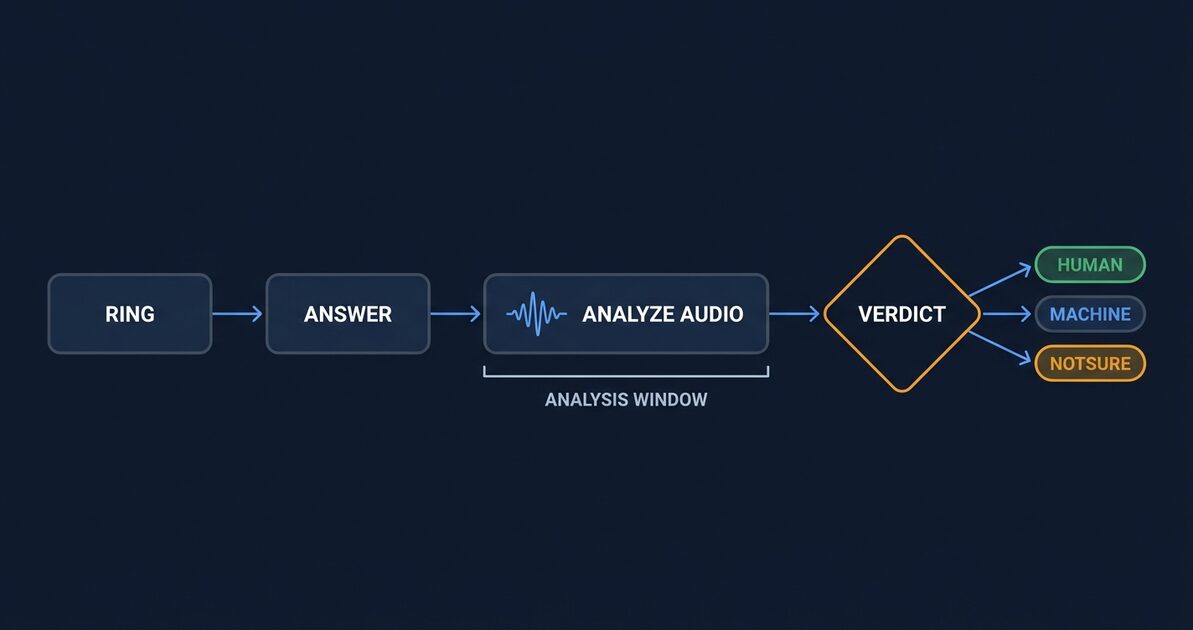
A left-to-right pipeline diagram showing how answering machine detection classifies an outbound call. Four stages connected by arrows: RING, then ANSWER, then ANALYZE AUDIO (drawn with a small waveform), then a diamond-shaped VERDICT decision point. A bracket under the ANALYZE AUDIO stage marks the analysis window, indicating that audio analysis only begins once the call is answered and runs for a bounded period before a decision must be returned. Three arrows leave the verdict diamond into three outcome chips: HUMAN, MACHINE, and NOTSURE. These are the three values Asterisk's app_amd writes to the AMDSTATUS channel variable; NOTSURE is highlighted in amber because it is the undecided outcome returned when no threshold is crossed within the analysis window. The diagram shows the mechanism only and contains no statistics.
How AMD classifies an answered call: the analysis window opens only after the answer signal, and stock Asterisk app_amd returns exactly three verdicts — HUMAN, MACHINE, or NOTSURE.

Legacy ViciDial AMD Problems

  • Estimated 10-20% AMD False Positive Rate: Standard Asterisk AMD misidentifies live humans as answering machines constantly.
  • Ghost Calls & Dead Air: Prospects answer, hear silence, and flag your number as spam.
  • FAS Issues: False Answer Supervision creates billing problems and dropped connections.
  • 120+ Burnt Leads Daily: A 10-agent call center loses $24,000/month to AMD false positives.

AMDY.IO AI Answering Machine Detection

  • 99% AI AMD Accuracy: Machine learning analyzes audio fingerprints, not just silence patterns.
  • Zero Dead Air: Every human "Hello" routes to an agent instantly. No ghost calls.
  • $24K+ Monthly Revenue Recovered: Stop hanging up on decision-makers.
  • TCPA & Ofcom Compliant: Eliminate silent/abandoned calls and protect your dialing reputation.
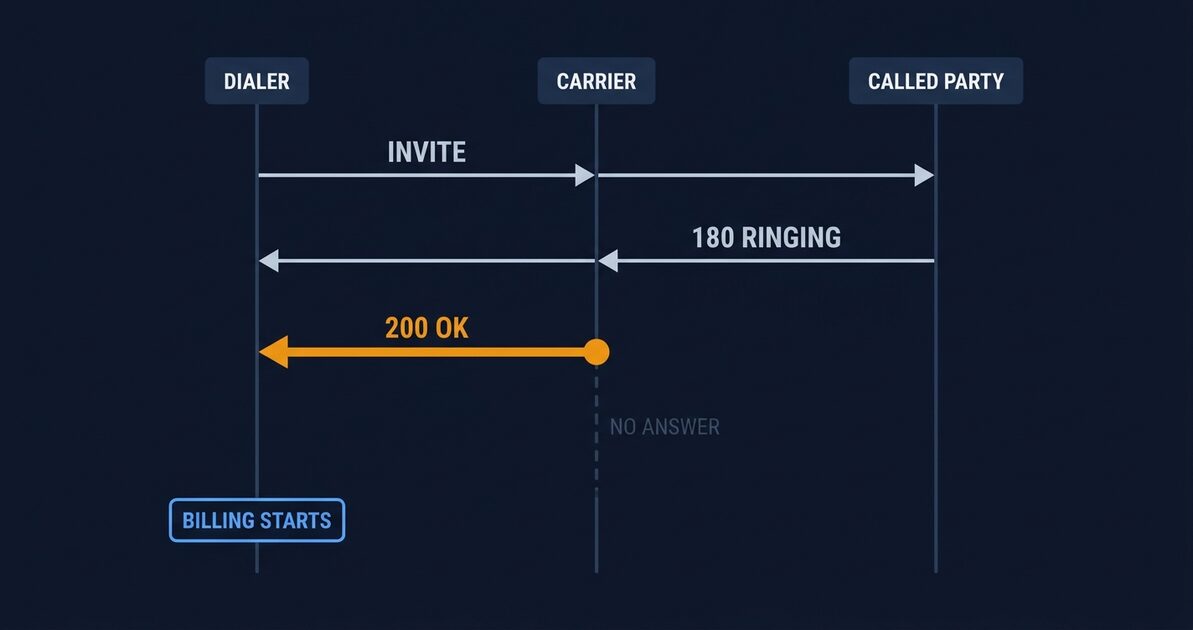
A SIP signalling ladder diagram with three vertical lifelines labelled DIALER on the left, CARRIER in the middle, and CALLED PARTY on the right, showing where carrier false answer supervision occurs. An INVITE travels left to right from the dialer through the carrier toward the called party, and a 180 Ringing provisional response comes back. Then, highlighted in amber, a 200 OK originates at the CARRIER lifeline itself and travels left to the dialer, rather than coming from the called party. The portion of the ladder between the carrier and the called party after that point is drawn as a faint dashed line marked NO ANSWER, showing that the far end never picked up. A small box at the dialer marks that billing and call state begin on receipt of the 200 OK. The point of the diagram is that the answer indication is generated inside the network, so the dialer believes it has a live connection while there is no human and no answering machine on the line, and any audio that follows is silence, an intercept tone, or a recorded network message. No statistics appear in the image.
Where a carrier false answer (FAS) happens in the SIP path: the 200 OK your dialer treats as an answer originates inside the network, not at the called party.

Why Choose AI-Powered AMD?

AMDY.IO's machine learning answering machine detection outperforms all legacy ViciDial AMD solutions.

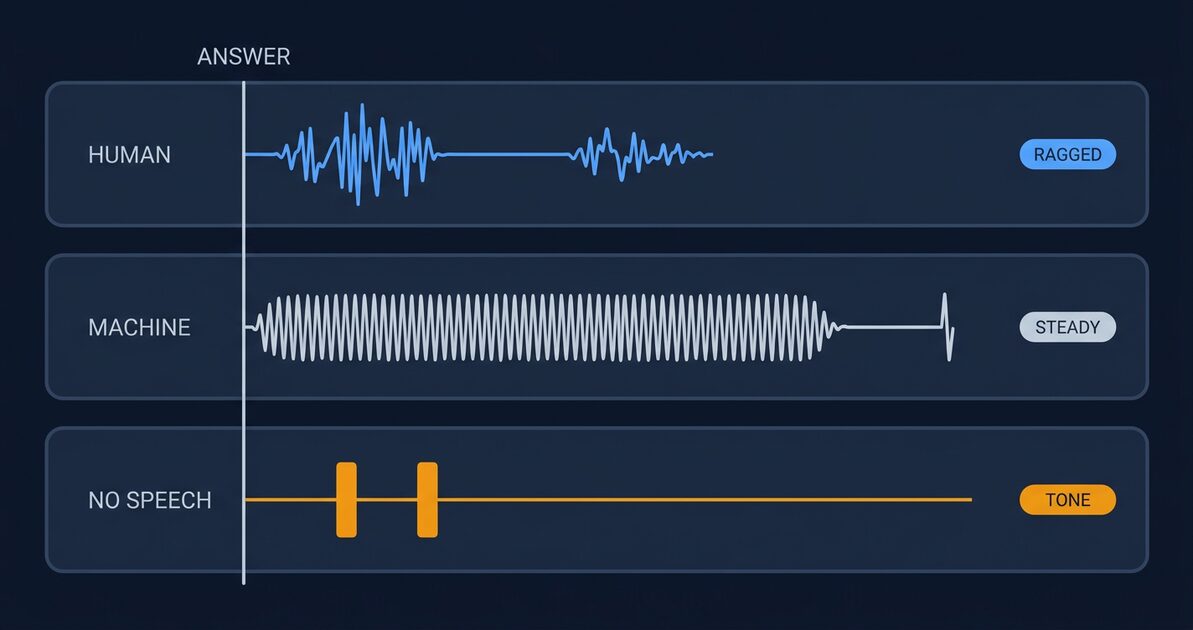
A three-lane waveform comparison showing what differs acoustically in the opening moment after a call is answered, all three lanes aligned to the same answer marker on the left. The top lane, labelled HUMAN, shows a ragged irregular waveform: a short uneven burst of voice, a gap, then a smaller burst, the pattern of a person saying a brief hello and then stopping to wait for a reply. The middle lane, labelled MACHINE, shows a steady even-amplitude continuous band of speech with regular rhythm and no early gap, the pattern of a recorded voicemail greeting playing through, ending in an isolated spike representing the tone at the end of the greeting. The bottom lane, labelled NO SPEECH, is mostly flat with two identical narrow pure-tone bars near the start, representing the answers that contain no speech at all: intercept and special information tones, fax signals, and dead air from carrier false answers. The diagram makes the case that the distinguishing information is in the shape and rhythm of the sound rather than in the words, which is why a transcription-based approach has nothing to read on the bottom lane and nothing to read yet on a human who answers in silence. The waveforms are illustrative shapes of the acoustic patterns, not captures of specific calls, and the image contains no numbers.
The first second after answer, three ways: a ragged human hello, a steady recorded greeting, and an answer with no speech at all (intercept tone, fax, or carrier dead air). Illustrative acoustic patterns, not captures of specific calls.

Recover Lost Revenue

Eliminate AMD false positives that cost call centers $24K+/month in lost connections.

Ultra-Low Latency

AI voicemail detection in milliseconds. No awkward pauses or dead air.

Eliminate Ghost Calls

Stop silent calls that damage caller ID reputation and violate regulations.

Boost Agent Productivity

Agents talk to humans, not voicemails. Improve morale and predictive dialer efficiency.

AI AMD ROI Calculator

AMDY.IO Delivers
50X Return On Investment

The revenue our AI answering machine detection recovers pays for the entire system in days, not months. Run the numbers for your own call volume.

$150M
Revenue Recovered
99%
AMD Accuracy Rate
Zero
Setup Fees

ViciDial & Asterisk AMD Integration

One-line install for ViciDial answering machine detection. WebSocket API for all other predictive dialers. Read the complete ViciDial AMD guide.

01

Integrate with ViciDial

Native one-line install for ViciDial, GoAutoDial, and Asterisk-based dialers. WebSocket API for auto dialers and power dialers.

02

AI Audio Analysis

Our machine learning AMD engine analyzes audio fingerprints in real-time with call progress detection (CPD) technology.

03

Connect Every Human

Humans route to agents instantly. Voicemail skip and voicemail drop handled automatically. No dead air or ghost calls.

Compatible with All Major Dialers

ViciDial GoAutoDial Asterisk FreePBX Issabel 3CX Power Dialer Progressive Dialer SIP Dialers WebSocket API

Answering Machine Detection FAQ

Common questions about ViciDial AMD, AI answering machine detection, dead air, and predictive dialer optimization.

A False Positive in AMD occurs when your answering machine detection system incorrectly identifies a live human caller as a voicemail. The predictive dialer then hangs up on the human, creating dead air or a "Ghost Call" where the prospect hears silence. Legacy ViciDial AMD systems are estimated to misclassify 10-20% of live humans as machines, while AMDY.IO's AI-powered AMD achieves less than 1%. Our live measured platform data is published on the features page.

Dead air and ghost calls in ViciDial occur when AMD false positives cause the dialer to hang up on live humans. FAS (False Answer Supervision) issues can also contribute, where carriers return answer signals prematurely. AMDY.IO eliminates dead air by using AI to distinguish humans from machines with 99% accuracy before routing calls.

AMDY.IO offers native one-line integration for ViciDial and Asterisk-based dialers. Simply add our integration script to your ViciDial configuration, and our AI AMD engine immediately begins analyzing call audio in real-time. For GoAutoDial, power dialers, and progressive dialers, we provide a robust WebSocket API.

For a 10-agent outbound call center with 600 live answers per day and a 20% false positive rate, you're hanging up on 120 decision-makers daily. At a 1% close rate and $1,000 deal value, that equals $24,000 in lost revenue per month, or $288,000 annually. AMDY.IO's AI answering machine detection eliminates these losses.

Yes. AMDY.IO's AI answering machine detection integrates with ViciDial, GoAutoDial, Asterisk, auto dialers, power dialers, progressive dialers, and any SIP-based predictive dialer via our WebSocket API. We support all major call center dialer software requiring voicemail detection and call progress detection (CPD).

Yes. We offer a free sandbox so you can audit your current ViciDial AMD connection rates against our AI answering machine detection. Compare your current false positive rate and dead air issues with AMDY.IO's 99% accuracy. See the difference in your pipeline immediately with zero risk.

Ready to Eliminate AMD False Positives?

Book a strategy call to integrate AI answering machine detection with your ViciDial or predictive dialer. Stop dead air and ghost calls today.